How to Choose the Right Piston Pump for Your Application?
How to Choose the Right Piston Pump for Your Application? The answer begins with the duty, not the catalogue photograph. A pump may look powerful, yet fail quickly under abrasive fluid, poor lubrication, or unstable suction conditions. The U.S. Department of Energy’s Improving Pumping System Performance sourcebook states that pumping systems can consume 25% to 50% of industrial motor electricity. The exact percentage varies by facility. It still makes efficiency a practical selection issue. Industry studies from Grand View Research and MarketsandMarkets also report continued demand for positive displacement pumps across chemical processing, water treatment, energy, and manufacturing. Their forecasts are not identical. That difference deserves attention.
Start with measurable operating details. Record required flow, discharge pressure, fluid viscosity, temperature, solids content, and daily running hours. Then check suction conditions, because insufficient NPSH can cause noise, vibration, and premature wear. A piston pump may deliver high pressure accurately, but its pulsating flow can affect piping, instruments, and downstream equipment. A pulsation dampener may be necessary. So may a stronger baseplate.
API Standard 674 provides recognized guidance for reciprocating positive displacement pump design and application. Use it with the manufacturer’s performance curves, material certificates, seal recommendations, and maintenance data. Experienced engineers also compare lifecycle cost, not only purchase price. A cheaper pump can become expensive after repeated valve, packing, or diaphragm replacement. No selection method is perfect. A neat spreadsheet helps, but it cannot predict every seal failure. The best choice comes from matching verified data with real operating experience, then reviewing the decision before installation.
Define the Pumping Requirements of Your Application
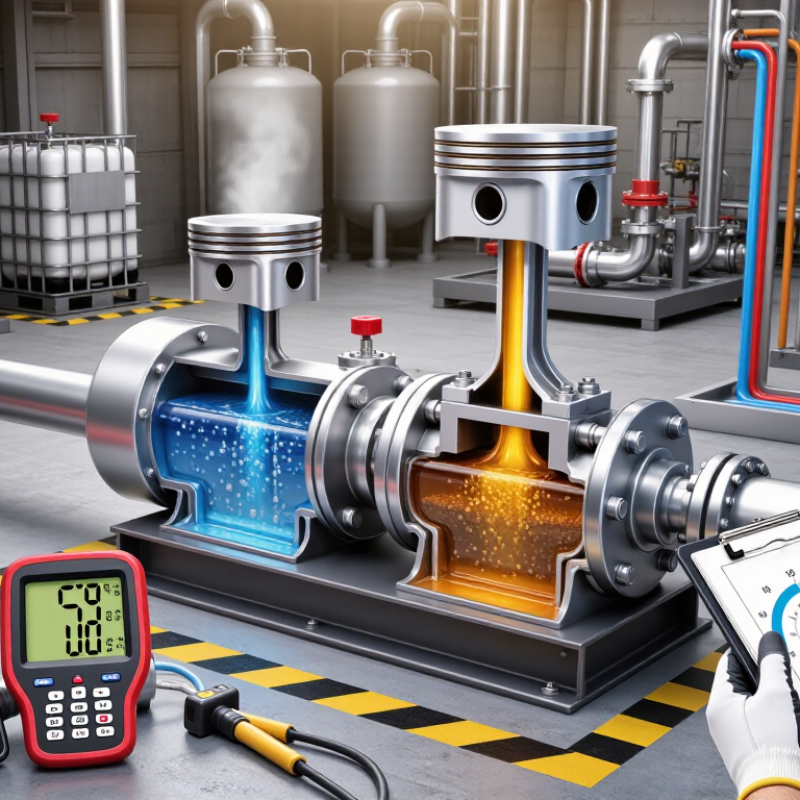
Choosing a piston pump begins with a clear definition of the work it must perform. Do not start with pressure alone. Record required flow, discharge pressure, fluid temperature, viscosity, density, and operating hours. Also identify whether the pump runs continuously, intermittently, or through frequent start-stop cycles. A process engineer I worked with once specified peak flow but missed the minimum flow. The result was unstable dosing during low-demand periods. That mistake was avoidable. Build a duty profile using normal, minimum, and maximum conditions. Include suction conditions, pipe length, elevation changes, and the number of valves and bends.
Fluid behavior deserves equal attention. Water-like liquids may be straightforward, while abrasive, corrosive, or gas-containing fluids can change pump selection significantly. Check solids size, particle concentration, lubricity, and chemical compatibility with wetted materials. For thick fluids, measure viscosity at the actual operating temperature, not only at room temperature. Piston pumps can deliver accurate flow, but poor inlet design may cause cavitation, vibration, and premature wear. Leave a realistic margin, but avoid excessive oversizing. A pump selected far above demand may cycle poorly and waste energy. Before approval, compare the duty profile with performance curves and request test data for unusual fluids. I would challenge every assumption that lacks a measurement. Some field estimates are useful, but they are not facts.
Match Piston Pump Design to Fluid and Pressure Conditions
Choosing the right piston pump begins with the fluid, not the catalogue pressure. Water, solvent, slurry, and high-viscosity oil create different demands on seals, valves, and cylinder materials. A practical selection review should record viscosity, temperature, solids content, corrosiveness, and required flow stability. A clean datasheet can still mislead.
Match the pump design to pressure behavior. Plunger pumps suit very high pressures and relatively low flows, while piston diaphragm designs provide stronger separation from abrasive or corrosive fluids. For fluids carrying particles, larger valve passages and slower operating speeds can reduce wear. However, slower is not always safer. Poor acceleration control may still create damaging pressure pulsations.
The U.S. Department of Energy’s Improving Pumping System Performance guide reports that optimized pumping systems can often reduce energy use by 30–50%. That saving depends on correct sizing, not simply installing a larger motor. The Hydraulic Institute also treats flow, differential pressure, viscosity, and duty cycle as essential pump-selection inputs. Those inputs should be measured under real operating conditions.
Check the suction line carefully. Even a strong piston pump can suffer cavitation when inlet pressure falls too low. Include pulsation dampeners when downstream instruments require steady flow. Specify relief protection and compatible wetted materials. I would also question laboratory data collected with clean water. It may not represent a fluid that warms, thickens, or carries solids during production. Expect some redesign after field testing.
How to Choose the Right Piston Pump for Your Application?
Match piston pump design to fluid properties and pressure conditions. The chart shows representative continuous discharge-pressure capabilities for common piston-pump configurations.
Axial piston pumps are commonly selected for clean hydraulic fluids and moderate-to-high pressure. Radial piston and triplex plunger pumps are better suited to higher-pressure service, while diaphragm piston pumps can provide improved separation when the fluid is corrosive, contaminated, or sensitive to leakage. Values are representative engineering references; always confirm materials, viscosity, temperature, speed, and duty cycle before selection.
Select the Right Materials, Size, and Drive Configuration
Choosing a piston pump starts with the fluid, not the catalog. Stainless steel may suit clean water, but abrasive slurry can demand hardened wetted parts. Corrosive chemicals may require stronger alloys and carefully matched seals. Temperature matters too. A seal that performs at 25°C can fail near 120°C. API 674 emphasizes material compatibility, pressure containment, and protection against overpressure in reciprocating pumps.
Sizing must reflect real duty conditions. Record flow, discharge pressure, suction pressure, viscosity, temperature, solids content, and daily operating hours. Do not size only for the maximum flow. Oversizing can increase pulsation, bypass losses, and maintenance. The U.S. Department of Energy reports that pumping systems may consume 25% to 50% of electricity in some industrial facilities. That makes efficient sizing financially important. A small site detail can change the result.
Drive configuration also shapes performance. A fixed-speed motor suits stable demand, while a variable-frequency drive can adjust output when process conditions change. However, speed reduction may affect lubrication, cooling, and minimum operating limits. Electric motors account for about half of global electricity consumption, according to the International Energy Agency’s Energy Efficiency 2023 report. Use a relief valve, pulsation dampener, and suitable control logic. Field checks often expose errors in assumed viscosity or suction conditions. The selection sheet is useful, but it is not the whole truth.
Evaluate Efficiency, Control Options, and Maintenance Needs
Choosing a piston pump starts with the duty cycle, not the catalog headline. Measure required flow, discharge pressure, fluid temperature, and operating hours. Efficiency matters most when the pump runs continuously. A small difference in volumetric efficiency can raise energy use and heat. Ask for performance data at your actual pressure, speed, and fluid viscosity. Laboratory figures may not match a dusty plant floor. Keep that in mind.
Control options should fit the process. Variable displacement control can reduce flow without throttling, saving power during partial demand. Pressure-compensated control suits changing loads, while electronic control offers precise ramping and remote monitoring. Yet more control hardware creates more settings to verify. I have seen a well-sized pump behave poorly because the control signal was noisy. A simple manual adjustment sometimes proved more stable. Do not select complexity without a clear operating benefit.
Maintenance needs should be judged before installation. Check access to filters, valves, seals, and inspection ports. A pump buried behind piping may be efficient but expensive to service. Review oil cleanliness requirements and plan sampling intervals. Use pressure and temperature trends to detect wear before output becomes unstable. Listen for cavitation. A sharp, gravel-like sound deserves immediate attention. Record baseline flow and noise during commissioning.
Seal life, alignment, and suction conditions also deserve practical checks. Poor inlet piping can damage a capable pump. Spare parts should match the expected service interval and storage conditions. I once underestimated contamination risk in a clean-looking workshop. That mistake changed the maintenance plan. Leave room for uncertainty, because real applications rarely stay within the original spreadsheet.
Verify Performance, Safety, and Long-Term Operating Costs
Choosing a piston pump starts with the duty, not the catalogue pressure. Record flow, discharge pressure, fluid temperature, viscosity, solids, and speed across the full operating cycle. A single design point is risky. In field assessments, actual demand often differs from the original specification. The U.S. Department of Energy’s Improving Pumping System Performance guide reports that pumping systems may consume 25–50% of industrial facility energy. Therefore, verify efficiency at minimum, normal, and peak flow. Request measured volumetric efficiency, pulsation behavior, and pressure stability. Test data matters.
Safety must be engineered into the selection. Confirm that the casing, plunger, seals, and fittings match maximum pressure, not normal pressure. Install an independent relief path, suitable guarding, leak detection, and emergency isolation. API Standard 674 addresses reciprocating positive-displacement pump design, including pressure-containing components and pulsation control. Also check fluid and temperature compatibility. Small seal swelling can become a serious failure. A certificate is not proof of safe installation.
Compare total cost over years. Include electricity, seals, valves, lubrication, calibration, downtime, disposal, and technician access. The Hydraulic Institute and Europump’s Pump Life Cycle Costs guide identifies energy as a major ownership expense. Yet buyers still focus on purchase price. That habit is costly. A lower-speed pump may cost more initially but reduce wear and noise. Oversizing can cause throttling losses and unstable operation. Vendor curves help, but site measurements should challenge them. Real conditions are rarely tidy.