
Top Aluminum Fin Press Machines for Global Buyers?
Choosing an Aluminum Fin Press Machine is not simply a matter of comparing tonnage and price. Global buyers must examine fin height, material thickness, coil width, stroke rate, die life, and feed accuracy. A machine may look impressive in a showroom, yet struggle with thin aluminum strip, unstable lubrication, or frequent die changes. Small details matter.
The International Aluminium Institute reports that global primary aluminum production has remained near 70 million metric tonnes annually in recent years. The Aluminum Association also notes that recycling aluminum can save up to 95% of the energy required for primary production. These figures explain why manufacturers increasingly demand efficient fin production, reduced scrap, and repeatable forming quality. An energy-efficient press is valuable. However, energy claims should be checked against actual motor ratings, production cycles, and factory data.
Materials expert Dr. Mark Miodownik wrote, “Materials are the foundation of civilization.” His observation applies directly to heat-exchanger manufacturing. Aluminum fins must remain lightweight, uniform, and mechanically reliable under demanding thermal conditions. This guide compares leading Aluminum Fin Press Machine options for global buyers, including servo feeding systems, pneumatic controls, quick-change tooling, safety design, and after-sales support. No ranking fits every factory. A high-speed press may benefit automotive production, while a slower, flexible model may suit custom HVAC orders. Buyers should request sample runs, measured tolerances, noise data, and maintenance records before deciding. That practical step is often missed.
What Aluminum Fin Press Machines Are and How They Work
Top Aluminum Fin Press Machines for Global Buyers
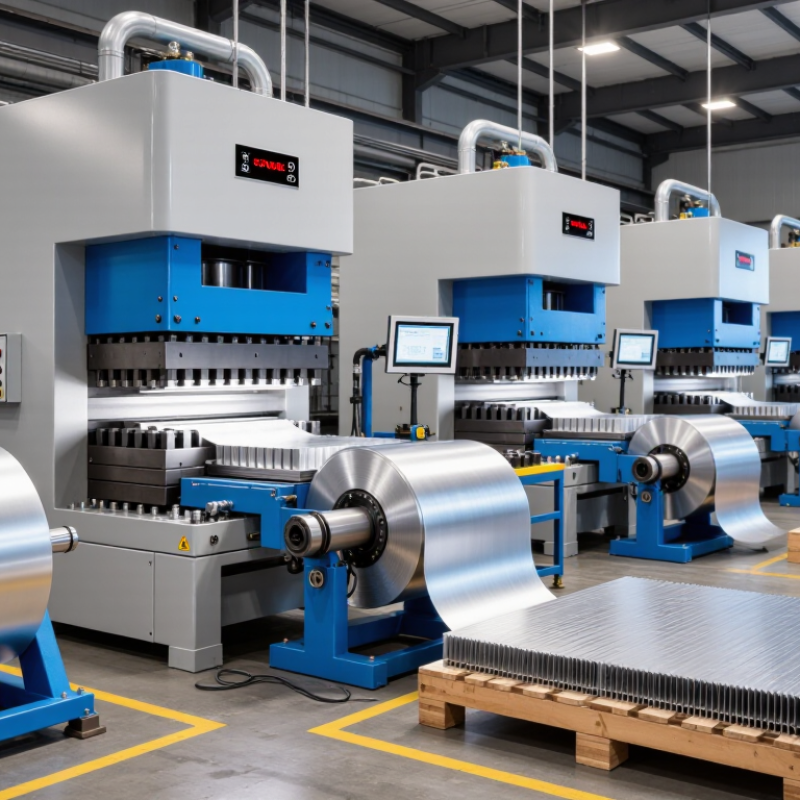
An aluminum fin press machine forms thin metal strip into fins for heat exchangers, radiators, and cooling units. It uses a controlled stamping process. A coil feeder moves aluminum through a forming die at a steady speed. The punch then creates waves, louvers, or other fin shapes. A cutting unit separates the finished sections.
The die controls fin height, pitch, and width. These details affect airflow and heat transfer. Operators adjust feed length, stroke speed, and material tension carefully. A small error matters. Excessive pressure can mark the aluminum or damage the tooling. Poor alignment may produce uneven fins and unstable stacks.
In practical factory use, reliable machines need rigid frames, accurate guides, and simple adjustment access. Buyers should check compatible aluminum thickness, maximum strip width, production speed, and changeover time. Automatic lubrication can reduce wear, but it cannot replace inspection. Dust, sharp scrap, and loose fasteners still cause trouble. I would also request sample parts before purchase. Specifications may look perfect on paper. Real output can reveal springback, burrs, or inconsistent fin spacing. Experienced operators know that the fastest press is not always the most useful one. A stable machine often delivers better long-term results.
Key Machine Types for Different Aluminum Fin Applications
Aluminum fin production rarely fits one machine type. The correct press depends on fin geometry, alloy temper, strip width, and production volume. A high-speed progressive fin press suits stamped heat exchanger fins with repeated louvers, collars, or slots. It feeds coil stock through several dies, forming features in one cycle. Operators should verify feed accuracy at the actual line speed. Small errors become visible as uneven fin stacks.
For plain, flat fins, a high-speed straight-side press with a simple blanking die can be more practical. It handles stable shapes and simplifies die maintenance. Deep-drawn or embossed fins need a servo press with controlled stroke and adjustable forming speed. This helps reduce tearing around beads and raised surfaces. Not every servo system improves quality automatically. Tool design still matters.
Tube-and-fin assemblies may require a dedicated fin collaring press. Its tooling creates collars around tube holes, supporting consistent tube expansion later. For prototypes or mixed orders, a mechanical press with quick die changes can reduce downtime. Check press tonnage, shut height, bolster size, lubrication access, and guarding before purchase. Ask for sample runs using your own aluminum coil. That test reveals springback, burrs, and scrap rates better than a brochure.
Maximum speed is not always productive speed. A slower machine may deliver cleaner edges and fewer stoppages. Record actual output across one full shift.
| Machine Type | Primary Aluminum Fin Application | Typical Material Thickness | Typical Strip Width | Typical Production Speed | Fin Geometry or Process | Best-Suited Products | Key Selection Considerations |
|---|---|---|---|---|---|---|---|
| High-Speed Continuous Fin Press | Automotive and industrial heat exchangers | Approximately 0.08–0.30 mm | Up to approximately 1,000 mm, depending on the tooling layout | Approximately 100–400 strokes/min | Continuous stamping with progressive dies; can produce louvered, plain, or wavy fins | Radiator, condenser, evaporator, and charge-air-cooler fins | Choose based on required stroke rate, strip-feeding accuracy, die life, scrap control, and compatibility with the target alloy and temper |
| Louver Fin Press | Automotive air-conditioning and compact heat exchangers | Approximately 0.08–0.20 mm | Approximately 300–900 mm | Approximately 150–350 strokes/min | Slitting and forming create angled louvers that increase air turbulence and heat-transfer area | Condenser and evaporator cores requiring high thermal performance | Review louver angle, louver pitch, fin height, burr control, and tooling stability at high production speeds |
| Wavy Fin Press | Air-cooled heat exchangers and refrigeration equipment | Approximately 0.10–0.30 mm | Approximately 250–1,000 mm | Approximately 100–300 strokes/min | Corrugating and forming produce a repeated wave profile for controlled airflow passages | Heat-exchanger coils, air coolers, and refrigeration condensers | Compare wave height, pitch, fin density, coil compatibility, and the machine’s ability to maintain consistent corrugation |
| Plain Fin Press | General-purpose heat-transfer components | Approximately 0.10–0.40 mm | Approximately 300–1,200 mm | Approximately 80–250 strokes/min | Flat-fin blanking, perforating, or light forming with relatively simple tooling | Basic radiator fins, ventilation heat exchangers, and custom fin assemblies | A practical choice for flexible production; evaluate changeover time, feed length accuracy, and tooling cost |
| Offset Fin Press | High-performance compact heat exchangers | Approximately 0.08–0.25 mm | Approximately 200–800 mm | Approximately 100–250 strokes/min | Creates alternating offset fin sections that increase mixing and heat-transfer performance | Plate-fin heat exchangers and compact thermal-management modules | Confirm offset height, fin pitch, flatness requirements, die alignment, and downstream stacking or brazing needs |
| Perforated Fin Press | Low-pressure-drop and enhanced-surface heat-transfer designs | Approximately 0.10–0.30 mm | Approximately 300–900 mm | Approximately 80–220 strokes/min | Punching creates holes, slots, or repeated openings in the aluminum strip | Ventilated fins, specialty coils, and airflow-optimized heat exchangers | Check perforation pattern, punching force, burr height, waste removal, and the required balance between airflow and heat transfer |
| Ladder Fin Press | Specialized evaporators and custom coil assemblies | Approximately 0.10–0.25 mm | Approximately 250–800 mm | Approximately 80–200 strokes/min | Forms repeated transverse bridges or ladder-like openings in the fin material | Custom refrigeration and air-conditioning heat-transfer components | Verify bridge dimensions, tube spacing, fin strength, die maintenance requirements, and product-specific feeding accuracy |
| Servo-Driven Precision Fin Press | Multi-format production and high-precision fin components | Approximately 0.08–0.40 mm | Approximately 200–1,200 mm | Approximately 60–300 strokes/min | Programmable servo motion supports variable forming profiles, controlled dwell, and precise feed synchronization | Mixed-product heat exchangers, prototype-to-volume production, and complex fin designs | Prioritize programmable stroke control, recipe management, energy consumption, changeover time, and integration with automatic inspection |
| Heavy-Duty Mechanical Fin Press | Thicker aluminum fins and large industrial heat exchangers | Approximately 0.30–1.00 mm | Approximately 500–1,500 mm | Approximately 30–150 strokes/min | High-force blanking, forming, and corrugating for robust fin structures | Industrial air coolers, large radiators, and durable ventilation systems | Assess rated tonnage, frame rigidity, die space, vibration control, safety guarding, and the required production volume |
| Automatic Fin Press Line with Stacker | High-volume coil and heat-exchanger manufacturing | Approximately 0.08–0.40 mm | Approximately 300–1,200 mm | Approximately 80–300 strokes/min | Integrated decoiling, straightening, feeding, fin forming, cutting, and automatic stacking | Large-scale production of repeatable fin packs and heat-exchanger cores | Evaluate line synchronization, stack accuracy, automation interfaces, floor space, coil capacity, and maintenance access |
Essential Specifications Global Buyers Should Compare
When comparing aluminum fin press machines, global buyers should begin with the material range, not the advertised stroke rate. Record strip thickness, width, fin height, pitch, and alloy grade. A machine designed for thin 0.08-millimeter stock may struggle with harder aluminum. Ask for verified output at your actual specifications.
Press force must match the die design and forming depth. Compare rated tonnage, stroke length, strokes per minute, and feeder accuracy under continuous production. A useful target is stable feed deviation below 0.02 millimeters, although the acceptable figure depends on fin geometry. Check motor power, lubrication access, die-change time, and noise readings at the operator position. Small details matter.
The International Aluminium Institute reports that recycled aluminum requires roughly 5% of the energy used for primary aluminum production. Therefore, buyers should examine scrap collection, lubricant control, and compatibility with recycled alloy batches. Waste reduction is not only an environmental issue; it affects material cost. ISO 12100 and ISO 13849 also provide important references for machine-risk assessment and control-system safety. Do not rely on certificates alone. Request test records, guarded access details, emergency-stop response, and maintenance intervals. A factory trial with your own coil is stronger evidence than a polished brochure. Some purchasing teams overlook operator training. That can become expensive.
Production, Quality, and Safety Features to Evaluate
Top Aluminum Fin Press Machines for Global Buyers?
Production, Quality, and Safety Features to Evaluate
Global buyers should evaluate output stability before headline speed. The International Aluminium Institute reported more than 70 million tonnes of primary aluminium production in 2023. That scale increases pressure on fin suppliers. A capable press should maintain feed accuracy, stroke consistency, and repeatable fin height during long coil runs. Check servo response, die alignment, and tooling-change time. Small alignment errors can create burrs, uneven spacing, or crushed fins. These defects may appear only after several hours.
Quality testing should use measurable evidence, not attractive samples. Request production records showing dimensional tolerance, scrap rate, and downtime. Inspect fin surfaces under direct light. Confirm flatness with calibrated gauges. Ask for sample coils and a documented acceptance test. ISO 9001-based quality controls help, but certification alone proves little. A perfect first-run assumption is risky. Real production is less tidy.
Tips: Test the machine with your aluminium alloy, thickness, and target speed. Confirm guarding, emergency stops, interlocks, and noise controls against ISO 12100 and ISO 13849 principles. The International Labour Organization estimates 2.93 million workers die annually from work-related factors. Safety deserves more than a checklist. Verify maintenance access, lockout procedures, and operator training. Ask for electrical schematics and spare-part guidance. Some buyers overlook access panels; technicians will not.
How to Select a Reliable Aluminum Fin Press Supplier
Top Aluminum Fin Press Machines for Global Buyers?
How to Select a Reliable Aluminum Fin Press Supplier
A reliable supplier should understand fin geometry, alloy behavior, and production pressure. Ask about maximum strip width, fin height, material thickness, and press speed. These details reveal whether the machine fits your heat exchanger design. Request a sample run using your actual aluminum coil. Measure fin pitch, burrs, flatness, and repeated dimensions. Ask for inspection records, not only attractive photographs. Details matter.
Visit the workshop virtually or in person. Check machining areas, assembly benches, testing equipment, and spare-part storage. A supplier should provide clear drawings, operating instructions, maintenance intervals, and delivery milestones. Confirm how technicians respond when a die wears early or a forming result changes. Slow answers are warning signs. Ask for proof.
Price deserves careful judgment. I once treated a low quotation as efficient, but missing tooling details created extra costs later. That mistake still influences my supplier checklist. Compare total ownership costs, including dies, training, shipping protection, energy use, and service visits. Check whether the supplier records machine performance after installation. A dependable partner discusses limitations openly, even when the answer may delay the order. Their experience should appear in tolerances, testing methods, and practical recommendations, not vague claims. Credible communication is part of machine quality.